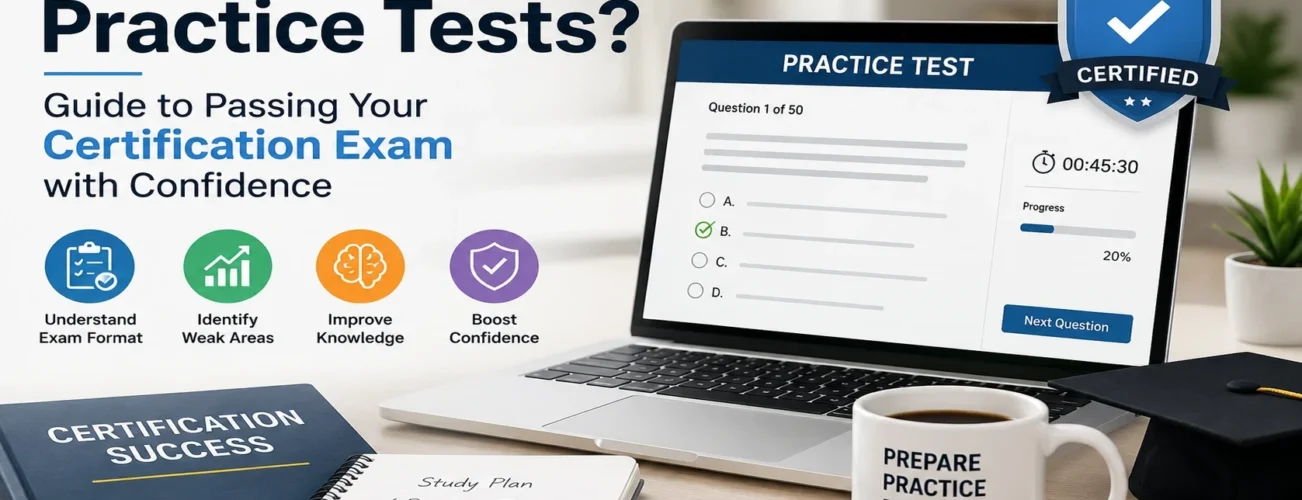
Preparing for an important exam can feel overwhelming. Whether you’re studying for a healthcare certification, business credential, teaching license, IT certification, trade qualification, or college entrance exam, one question often comes up: What’s the best way to prepare?
Most people begin by reading textbooks, highlighting notes, watching videos, or reviewing flashcards. While these methods are useful, they don’t always reveal how well you’ve actually learned the material. Many candidates feel confident while studying, only to discover during the real exam that recalling information under pressure is much harder than expected.
This is where practice tests become one of the most valuable learning tools available.
Practice tests do far more than measure what you know. They strengthen memory, improve critical thinking, reveal weak areas, reduce exam anxiety, and prepare you for the experience of taking the real test. Research in educational psychology consistently shows that testing yourself is one of the most effective ways to retain information over the long term. Instead of passively reviewing content, practice tests require you to actively retrieve knowledge, making learning stronger and more durable.
Whether you’re preparing weeks in advance or reviewing during the final days before your exam, incorporating practice tests into your study routine can significantly improve your readiness and confidence.
What Are Practice Tests?
A practice test is a collection of questions designed to simulate the format, style, and subject matter of an actual examination. Its purpose is not simply to tell you whether your answers are right or wrong—it helps you evaluate your understanding, identify knowledge gaps, and develop the skills needed to perform well under exam conditions.
Unlike quizzes used only for classroom grading, practice tests are learning tools. They give you an opportunity to apply what you’ve studied, think through problems independently, and become familiar with the way questions are presented.
Depending on the exam you’re preparing for, practice tests may include:
- Multiple-choice questions
- True or false questions
- Scenario-based questions
- Clinical or case-study questions
- Situational judgment questions
- Calculation problems
- Matching exercises
- Short-answer questions
Professional certification exams often present realistic situations rather than simple factual questions. Instead of asking you to define a concept, they may ask how that concept should be applied in a specific scenario. High-quality practice tests mirror this approach, helping you develop analytical thinking instead of relying on memorization.
For example, a nursing candidate may be asked to prioritize patient care, while an accounting student may need to interpret financial information before selecting the correct answer. An IT professional might troubleshoot a network issue, and a teacher may analyze a classroom scenario. In each case, success depends on understanding—not simply remembering facts.
Why Practice Tests Matter More Than Ever
Modern examinations have changed dramatically over the past decade. Certification organizations, universities, and licensing boards are placing greater emphasis on real-world problem solving rather than simple recall.
Employers want professionals who can apply their knowledge confidently, make informed decisions, and adapt to changing situations. As a result, today’s exams are designed to measure practical understanding.
This shift explains why candidates who spend hours reading textbooks sometimes struggle on exam day. Reading creates familiarity, but familiarity isn’t the same as mastery.
Practice tests bridge this gap by requiring you to think, analyze, and make decisions without immediately looking up the answer. Every question becomes an opportunity to strengthen your understanding while exposing areas that need more attention.
They also introduce you to the style and pacing of the real exam. Becoming familiar with question wording and time constraints helps reduce surprises and improves your ability to stay focused during the actual test.
How Modern Certification Exams Are Designed
Understanding how certification exams are created can help you appreciate why practice tests are such an important part of preparation.
Most professional examinations are developed through a structured process involving subject matter experts, educators, and industry professionals. These experts identify the knowledge and skills required for competent practice, then create exam blueprints that define what candidates should know.
Questions are written to assess different levels of learning, including:
Knowledge
Can you recall important facts, terminology, or definitions?
Understanding
Can you explain concepts and recognize their meaning?
Application
Can you use your knowledge to solve practical problems?
Analysis
Can you evaluate information, identify patterns, and make appropriate decisions?
The higher the level of certification, the greater the emphasis on application and analysis. This is why many candidates discover that simply memorizing information is not enough.
Practice tests prepare you for these higher-order thinking skills by encouraging active problem solving rather than passive review.
Why Reading Alone Isn’t Enough
Reading is an essential part of learning, but it has limitations when used as the only study strategy.
Many students mistake recognition for understanding. After reading the same chapter several times, the material begins to feel familiar. However, familiarity can create a false sense of confidence.
When you later face a question without the textbook in front of you, recalling the information may prove surprisingly difficult.
Imagine reading a chapter about infection control. While the content may seem clear during study, answering a scenario-based question about selecting the correct protective equipment requires much deeper understanding.
Practice tests reveal whether you can retrieve information independently.
Instead of recognizing an answer after seeing it, you must produce it from memory. That process strengthens learning far more effectively than repeated reading.
Educational researchers often describe this as the difference between knowing and being able to use what you know.
Real exams reward the second skill.
The Difference Between Studying and Learning
Many people use the words studying and learning interchangeably, but they are not exactly the same.
Studying is the process of reviewing information. Learning occurs when that information becomes part of your long-term knowledge and can be applied accurately when needed.
Consider these common study activities:
- Reading textbooks
- Watching online lectures
- Highlighting important sentences
- Reviewing notes
- Listening to recorded lessons
These methods are valuable because they introduce new concepts. However, they often involve passive learning, where information flows from the source to the learner without requiring much mental effort.
Practice tests change that dynamic completely.
Instead of absorbing information, you actively search your memory, evaluate possible answers, compare options, and justify your decisions. This process creates stronger neural connections and improves long-term retention.
Think of learning a new language. Reading vocabulary lists helps you recognize words, but speaking the language forces you to recall those words without assistance. That active effort accelerates learning.
Exam preparation works in much the same way.
The more frequently you retrieve information through practice questions, the easier it becomes to recall that knowledge during the real examination.
Practice Tests Encourage Active Learning
One of the biggest advantages of practice tests is that they transform learners from passive readers into active participants.
Rather than simply reviewing material, you begin interacting with it.
Each question asks you to:
- Recall previously learned information.
- Interpret the meaning of the question.
- Analyze the available answer choices.
- Eliminate incorrect options.
- Select the most appropriate response.
- Reflect on why the correct answer is right.
This sequence strengthens multiple cognitive skills at the same time.
Even when you answer incorrectly, valuable learning still takes place. Reviewing explanations helps correct misunderstandings before they become habits, making future recall more accurate.
Over time, repeated practice creates a stronger foundation of knowledge that is easier to access under exam pressure.
Building a Smarter Study Routine
Successful candidates rarely depend on a single study method. Instead, they combine several strategies that complement one another.
A balanced study plan often includes:
- Reading textbooks to build foundational knowledge.
- Watching instructional videos for complex concepts.
- Reviewing class notes and study guides.
- Creating summaries or concept maps.
- Completing regular practice tests.
- Reviewing answer explanations carefully.
- Revisiting weaker subjects until they become strengths.
This combination supports both understanding and application, helping learners move beyond memorization toward genuine mastery.
Practice tests should not replace textbooks or lectures—they should reinforce them. By integrating regular self-assessment into your routine, you gain continuous feedback about your progress and can make informed decisions about where to focus your remaining study time.
The Science Behind Practice Tests: Why They Really Work
Have you ever finished reading a chapter, felt confident about the material, and then struggled to answer even basic questions a few days later? This is a common experience, and it highlights an important truth about learning: reading information is not the same as remembering it.
Educational psychologists have spent decades studying how people learn and retain information. One of the most consistent findings is that actively retrieving information from memory strengthens learning far more effectively than simply reviewing it repeatedly. This principle is known as retrieval practice, and it explains why practice tests are such a powerful study tool.
Every time you answer a question without looking at your notes, your brain searches for the information it has stored. That mental effort reinforces the pathways associated with the knowledge, making it easier to recall later. In simple terms, every successful retrieval makes future retrieval easier.
This is why candidates who regularly complete practice tests often remember more on exam day than those who only reread textbooks.
Practice Tests Improve Long-Term Memory
Many learners focus on remembering information long enough to pass an exam. While that may seem like the goal, healthcare professionals, teachers, accountants, engineers, IT specialists, and other certified professionals need knowledge that lasts beyond test day.
Practice tests help move information from short-term memory into long-term memory.
When you repeatedly retrieve information over several days or weeks, your brain treats that knowledge as important. As a result, it becomes easier to access when needed.
For example, imagine you’re preparing for a medical terminology exam. Reading a list of terms several times may help you recognize them, but answering questions about those terms from memory requires deeper processing. By working through multiple practice questions over time, you’re far more likely to remember the terminology weeks or even months later.
This process benefits not only your exam performance but also your future career, where quick and accurate recall is often essential.
Learning From Mistakes Is Part of the Process
Many candidates become discouraged when they score poorly on their first practice test. In reality, making mistakes during practice is one of the most valuable parts of learning.
A practice test is not a final judgment of your abilities. It is a diagnostic tool that reveals where additional study is needed.
Every incorrect answer provides useful feedback:
- Which concepts need further review?
- Did you misunderstand the question?
- Were you rushing through the answers?
- Is there a recurring topic that needs more attention?
When you carefully review your mistakes and understand why the correct answer is right, you reduce the chances of making the same error again.
This cycle—practice, review, improve, and repeat—is how steady progress is made.
Practice Tests Build Confidence Before Exam Day
Confidence doesn’t come from hoping you’ll remember everything. It comes from knowing you’ve prepared thoroughly.
Each completed practice test gives you valuable experience answering questions under conditions similar to the real exam. Over time, the testing process begins to feel familiar rather than intimidating.
This familiarity has several benefits:
- You become comfortable with exam-style questions.
- You improve your ability to manage time.
- You learn how to stay focused during longer exams.
- You become less anxious when faced with challenging scenarios.
- You develop confidence in your decision-making.
By the time exam day arrives, you’ve already answered hundreds of similar questions. The testing environment feels much less intimidating because you’ve practiced it repeatedly.
Developing Better Critical Thinking Skills
Many professional examinations evaluate more than factual knowledge. They assess whether you can interpret information, analyze situations, and make sound decisions.
Practice tests encourage these higher-level thinking skills.
Instead of asking yourself, “What fact do I remember?” you begin asking questions such as:
- What is the problem being presented?
- Which information is most important?
- Which answer best fits the situation?
- Why are the other options incorrect?
This type of reasoning mirrors the challenges professionals encounter in the workplace.
A nurse may need to prioritize patient care. An accountant may evaluate financial records before making recommendations. An IT technician may diagnose a technical issue using several pieces of evidence.
Practice questions help develop the structured thinking needed in both examinations and professional practice.
Reducing Exam Anxiety Through Familiarity
Test anxiety affects many students, even those who are well prepared.
One reason anxiety develops is uncertainty. Candidates often worry about the types of questions they’ll encounter, how difficult the exam will be, or whether they’ll manage their time effectively.
Practice tests reduce this uncertainty by making the exam experience more familiar.
The more often you practice under timed conditions, the more comfortable you become with:
- Reading complex questions carefully.
- Managing limited exam time.
- Maintaining concentration.
- Recovering after difficult questions.
- Moving confidently from one section to the next.
Instead of wondering what to expect, you’ll approach the exam with a clear understanding of its format and pace.
Practice Tests Help You Identify Weak Areas
Every learner has strengths and weaknesses.
Without regular self-assessment, it’s easy to spend too much time reviewing topics you already understand while overlooking areas that need improvement.
Practice tests provide objective feedback.
After completing several exams, patterns begin to emerge.
Perhaps you’re consistently strong in anatomy but weaker in pharmacology. Maybe you perform well on calculations but struggle with scenario-based questions.
Recognizing these trends allows you to focus your study time where it will have the greatest impact.
This targeted approach is far more effective than reviewing every chapter equally.
Turning Knowledge Into Exam Readiness
Knowing the material is only one part of passing an exam.
You also need to know how to apply that knowledge under pressure.
Practice tests help bridge the gap between learning and performance.
They teach you to:
- Read questions carefully.
- Avoid common traps.
- Eliminate incorrect answers.
- Prioritize key information.
- Make informed decisions within time limits.
These practical testing skills often make a significant difference, especially on professional certification exams where careful analysis is just as important as subject knowledge.
Practice Tests Support Every Type of Learner
No two students learn in exactly the same way.
Some prefer reading textbooks, while others learn better through visual demonstrations or classroom discussions.
Practice tests complement nearly every learning style because they focus on application rather than presentation.
Whether you’ve learned through lectures, videos, textbooks, online courses, or independent study, answering questions allows you to measure how effectively you’ve absorbed the material.
They also encourage consistent study habits by providing regular milestones and helping you monitor progress over time.
Practice Is the Foundation of Success
Think about any profession that requires a high level of performance.
Athletes don’t prepare for competitions by reading rulebooks alone—they practice repeatedly. Musicians rehearse before concerts. Pilots spend hours in flight simulators before flying passengers. Surgeons refine techniques through years of supervised training.
Examinations are no different.
The more opportunities you have to apply your knowledge before the real exam, the more prepared you’ll be when it matters most.
Practice tests give you those opportunities in a structured, measurable, and purposeful way.
They help transform information into understanding, understanding into confidence, and confidence into success.
How Practice Tests Help You Pass the Real Exam
By the time you reach the final weeks before an exam, you’ve likely spent countless hours reading textbooks, reviewing notes, watching lectures, and memorizing important concepts. While those activities build knowledge, they don’t always prepare you for one of the biggest challenges you’ll face on exam day—applying that knowledge under pressure.
This is where practice tests make a meaningful difference.
Rather than asking you to simply recognize information, practice tests require you to retrieve it, evaluate multiple answer choices, and apply your understanding to realistic questions. That process closely mirrors what happens during the actual examination.
Candidates who regularly complete high-quality practice tests often enter the testing center feeling more prepared because they’ve already experienced the types of questions, time constraints, and decision-making required to succeed.
Practice doesn’t guarantee a passing score, but it significantly improves your readiness by helping you understand both the subject matter and the exam itself.
1. Practice Tests Reveal What You Really Know
It’s easy to assume you’ve mastered a topic after reading it several times. However, true understanding is only revealed when you’re asked to recall the information without assistance.
Practice tests provide an honest assessment of your current knowledge.
They answer important questions such as:
- Which topics do you understand well?
- Which concepts require additional review?
- Are you making careless mistakes?
- Do you struggle with certain question formats?
- Are you managing your time effectively?
This feedback allows you to adjust your study plan based on actual performance rather than assumptions.
2. They Help You Focus on Weak Areas
One of the biggest advantages of practice testing is efficient studying.
Without regular self-assessment, many students spend too much time reviewing topics they already know because they feel comfortable. Unfortunately, this leaves less time for subjects that genuinely need attention.
Practice test results make your strengths and weaknesses much clearer.
For example, you may discover that you consistently score well in anatomy but struggle with pharmacology, or that you’re comfortable with theory but lose points on scenario-based questions.
Knowing where you need improvement allows you to concentrate your efforts where they’ll have the greatest impact.
3. Practice Tests Improve Time Management
Many certification exams are timed.
Even candidates with strong subject knowledge can struggle if they spend too long on difficult questions.
Practice tests help you develop a sense of pacing.
As you complete more exams under realistic conditions, you learn how long you can reasonably spend on each question, when it’s better to move on, and how to leave enough time for review before submitting your answers.
These time management skills often reduce stress and improve overall performance during the actual exam.
4. They Strengthen Critical Thinking
Modern examinations rarely ask only factual questions.
Instead, they present situations that require analysis, prioritization, and judgment.
Practice questions help strengthen these higher-order thinking skills by encouraging you to:
- Interpret information carefully.
- Compare multiple answer choices.
- Identify the most appropriate solution.
- Apply knowledge to unfamiliar situations.
- Evaluate possible outcomes before making a decision.
These skills are valuable not only for passing certification exams but also for succeeding in your future profession.
5. Practice Tests Reduce Careless Mistakes
Not every incorrect answer is caused by a lack of knowledge.
Sometimes candidates:
- Misread the question.
- Ignore important keywords.
- Rush through the options.
- Select the first answer that appears correct.
- Change correct answers unnecessarily.
Completing regular practice tests helps you recognize these habits before exam day.
Over time, you become more disciplined in reading carefully, evaluating every option, and avoiding avoidable errors.
6. They Improve Decision-Making Under Pressure
Examinations place candidates in situations where decisions must be made within limited time.
The ability to remain calm while evaluating multiple choices is a skill that improves with experience.
Practice testing provides repeated opportunities to develop that skill.
As your confidence grows, you’ll become more comfortable handling difficult questions without becoming overwhelmed or second-guessing every answer.
How to Use Practice Tests Effectively
Simply completing dozens of practice exams isn’t enough.
The greatest improvements come from how you use them.
Successful candidates typically follow a structured approach rather than rushing through questions simply to achieve a high score.
Begin With Learning
Before attempting full-length practice exams, develop a solid understanding of the core concepts through textbooks, lectures, online courses, or study guides.
Practice tests work best when they reinforce existing knowledge rather than introduce entirely new material.
Simulate Real Testing Conditions
Whenever possible, recreate the environment of your actual exam.
Choose a quiet location, eliminate distractions, and complete the practice test within the recommended time limit.
Avoid checking notes or searching for answers while the test is in progress.
This helps you develop both confidence and endurance.
Review Every Answer Carefully
Many learners make the mistake of checking their score and immediately moving to another test.
The real learning happens after the exam is finished.
Review:
- Every incorrect answer.
- Every question you guessed correctly.
- Every explanation provided.
- The concepts behind difficult questions.
Even correct answers deserve attention if you weren’t completely confident when selecting them.
Keep a Study Journal
Maintaining a simple notebook or digital document can significantly improve your preparation.
After each practice test, record:
- Topics you struggled with.
- Frequently repeated mistakes.
- New concepts you learned.
- Areas that require additional review.
Over several weeks, this record becomes a personalized study guide focused entirely on your individual needs.
Common Mistakes When Using Practice Tests
Although practice tests are extremely effective, they can lose much of their value if used incorrectly.
Some of the most common mistakes include:
Taking Practice Tests Too Early
If you’ve never studied the subject, scoring poorly on an advanced practice exam can be discouraging.
Build a foundation first, then begin using practice tests to reinforce what you’ve learned.
Memorizing Answers Instead of Understanding Them
Repeatedly choosing the correct option without understanding why it is correct provides very little educational value.
Focus on learning the underlying concept rather than remembering the letter associated with the answer.
Ignoring Incorrect Questions
Some students skip explanations after getting a question wrong because they feel frustrated.
In reality, incorrect answers often provide the greatest learning opportunities.
Treat every mistake as valuable feedback rather than failure.
Focusing Only on Final Scores
Your score is useful, but it shouldn’t be your only measure of progress.
Also consider:
- Are you making fewer careless mistakes?
- Are you finishing within the time limit?
- Are you improving in weaker subjects?
- Do you feel more confident than last week?
These improvements often indicate meaningful progress even before your overall score increases.
Consistency Produces Better Results
One long study session before an exam is rarely as effective as consistent preparation over time.
Completing practice tests regularly—even a small number of questions each day—helps reinforce learning while reducing the need for last-minute cramming.
Steady progress allows your knowledge to build naturally, giving you more opportunities to review difficult topics and strengthen your understanding before exam day.
The goal isn’t simply to answer more questions. It’s to learn something valuable every time you practice.
When Should You Start Taking Practice Tests?
One of the most common questions students ask is, “When is the right time to begin taking practice tests?” The answer depends on your familiarity with the subject, but one thing is certain—you shouldn’t wait until the final few days before your exam.
Practice tests are most effective when they become a regular part of your study plan rather than a last-minute activity. In the early stages of preparation, short quizzes or topic-based practice questions can help reinforce newly learned concepts. As your understanding grows, you can gradually move to longer and more comprehensive practice exams that simulate the real testing experience.
By spreading practice throughout your study schedule, you’ll have time to identify weak areas, strengthen difficult subjects, and monitor your progress over several weeks instead of trying to fix everything at the last minute.
How Many Practice Tests Should You Complete?
There isn’t a universal number that guarantees success because every exam and every learner is different.
Instead of aiming for a specific number of practice tests, focus on achieving consistent improvement.
You’re generally ready for your real exam when you can:
- Consistently score well across multiple practice exams.
- Explain why the correct answer is right without guessing.
- Complete the exam comfortably within the time limit.
- Feel confident answering questions from every major topic.
- Make fewer careless mistakes than when you first started.
For some candidates, this may require only a handful of full-length practice exams. Others may benefit from completing dozens of topic-specific quizzes before attempting comprehensive tests.
Quality practice always matters more than quantity.
Should You Retake the Same Practice Test?
Yes—but only after giving yourself enough time to forget the exact questions.
Retaking a practice test can be a valuable way to measure improvement and confirm that you’ve truly learned the material. However, if you repeat the same questions too soon, you may remember the answers instead of demonstrating genuine understanding.
A better strategy is to alternate between different practice tests covering the same topics. Later, revisit earlier exams to evaluate how much your knowledge has improved.
If your score increases because you understand the concepts—not because you memorized the answers—you’ll know your preparation is moving in the right direction.
Practice Tests for Different Types of Exams
Although every certification exam has its own objectives, practice tests benefit learners across virtually every field.
Healthcare and Nursing Exams
Practice questions strengthen clinical reasoning, patient safety awareness, pharmacology knowledge, anatomy, medical terminology, and decision-making skills.
IT and Technology Certifications
Scenario-based practice helps candidates troubleshoot technical problems, understand networking concepts, improve cybersecurity knowledge, and apply software or cloud computing principles.
Business and Accounting Exams
Candidates improve their ability to analyze financial information, apply regulations, interpret business scenarios, and solve quantitative problems accurately.
Teaching and Education Exams
Practice tests help future educators strengthen instructional planning, classroom management, educational psychology, assessment strategies, and professional ethics.
Trade and Skilled Profession Exams
Electricians, HVAC technicians, mechanics, construction professionals, and other skilled workers benefit from applying technical knowledge to practical situations similar to those encountered in the workplace.
No matter which profession you’re preparing for, practice tests encourage active learning and improve your ability to apply knowledge when it matters most.
How to Get the Most from Practice Tests
One of the biggest mistakes candidates make is taking practice tests without a clear study strategy. To improve your score, simulate real exam conditions, review every incorrect answer, identify weak subjects, and repeat practice regularly. If you’re preparing for a healthcare or nursing certification, our comprehensive guide on How to Prepare for Any Nursing Certification Exam explains how to create a study schedule, manage your time, and use practice tests effectively throughout your preparation.
Practice tests work best when they are combined with a consistent study plan and targeted review. Students can also use additional exam preparation tips to organize their study time, identify weak areas, and make their practice sessions more effective.
Building a Balanced Study Plan
The most successful candidates rarely rely on one study method alone. Instead, they combine several proven learning techniques into a structured routine.
An effective study plan may include:
- Reading textbooks and official study guides.
- Watching educational videos or attending lectures.
- Reviewing notes after each study session.
- Creating flashcards for key terms and formulas.
- Completing topic-based quizzes regularly.
- Taking full-length practice exams under timed conditions.
- Carefully reviewing answer explanations.
- Revisiting weaker subjects until they become strengths.
This balanced approach helps reinforce knowledge from multiple angles while preventing burnout from repetitive study methods.
Measuring Your Progress
Progress isn’t measured only by higher scores.
Many other signs indicate that your preparation is improving, including:
- Answering questions more confidently.
- Finishing exams with time remaining.
- Understanding explanations more quickly.
- Recognizing common question patterns.
- Making fewer careless errors.
- Feeling less anxious before practice sessions.
- Explaining concepts to others without referring to notes.
These improvements often develop gradually and demonstrate that your knowledge is becoming more organized and easier to retrieve.
Frequently Asked Questions
Are practice tests harder than the real exam?
High-quality practice tests are designed to reflect the style, structure, and difficulty of actual examinations. Some may feel slightly more challenging because they are intended to prepare you for a wide range of possible questions.
Can practice tests guarantee that I’ll pass?
No study resource can guarantee a passing score. However, practice tests can significantly improve your preparation by strengthening knowledge, identifying weak areas, and helping you become familiar with exam conditions.
Is it normal to score poorly at first?
Yes. Many candidates achieve lower scores on their first few practice tests. Early practice exams are intended to reveal knowledge gaps so you can improve before taking the real exam.
Should I review explanations even when I answer correctly?
Absolutely. Reviewing explanations reinforces your understanding and helps confirm that you selected the correct answer for the right reason rather than by guessing.
How often should I take practice tests?
The ideal frequency depends on your study schedule and exam date. Many learners benefit from completing shorter quizzes several times a week and full-length practice exams periodically throughout their preparation.
Final Thoughts
Passing an important exam is rarely the result of luck. It comes from consistent preparation, thoughtful review, and a willingness to learn from every study session.
Practice tests play an important role because they transform passive studying into active learning. They help you identify weaknesses before exam day, strengthen long-term memory, improve critical thinking, reduce anxiety, and develop the confidence needed to perform under pressure.
Whether you’re preparing for a healthcare certification, nursing exam, business credential, IT certification, teaching license, trade qualification, legal examination, or any other professional assessment, practice tests provide valuable insight into your readiness while helping you become a more effective learner.
Remember that success isn’t measured by the number of hours you spend studying. It’s measured by how effectively you use those hours. Reading textbooks builds knowledge, but applying that knowledge through practice is what prepares you for real exam questions.
Treat every practice test as another opportunity to improve. Learn from every incorrect answer, celebrate your progress, and continue building your confidence one question at a time.
When exam day finally arrives, you’ll know you haven’t simply studied the material—you’ve practiced applying it.
That preparation can make all the difference.
Start Preparing Smarter with ExamFellow
At ExamFellow, we believe that meaningful learning comes from consistent practice and high-quality educational resources. Our growing collection of practice tests is designed to help students, professionals, and certification candidates prepare with confidence across healthcare, nursing, business, accounting, teaching, technology, and many other career fields.
Explore our practice test library to find realistic exam questions, detailed answer explanations, and study resources that support your certification goals. Whether you’re taking your first professional exam or pursuing an advanced credential, ExamFellow is here to help you study smarter, strengthen your knowledge, and approach your exam with confidence.
Start Preparing Smarter with ExamFellow
At ExamFellow, we believe that meaningful learning comes from consistent practice and high-quality educational resources. Our growing collection of practice tests is designed to help students, professionals, and certification candidates prepare with confidence across healthcare, nursing, medical sciences, chemistry, and many other career fields.
Whether you’re preparing for a healthcare certification, nursing exam, medical licensing test, or science-based assessment, you’ll find realistic exam questions, detailed answer explanations, and exam-focused study resources to support your success.
| Practice Test Category | Description |
|---|---|
Healthcare Practice Tests | Prepare for healthcare certification exams with realistic practice questions covering allied health, patient care, healthcare administration, coding, pharmacy, and more. |
Nursing Practice Tests | Build confidence for NCLEX and nursing certification exams through comprehensive nursing practice questions, clinical scenarios, and detailed explanations. |
Medical Practice Tests | Strengthen your understanding of medical terminology, anatomy, physiology, diagnostics, and clinical concepts with exam-style medical practice tests. |
Chemistry Practice Tests | Master general, organic, analytical, and applied chemistry concepts with practice exams designed for academic and professional success. |
Explore our growing collection of certification and academic practice exams to strengthen your knowledge, improve exam readiness, and approach your next test with confidence. Every practice test is designed to help you learn smarter, identify weak areas, and prepare for success.